
As an Amazon Associate I earn from qualifying purchases. Affiliate disclosure
Most RV water softeners are compact, salt-based tanks you hook up between the park faucet and your rig. They swap hardness minerals for sodium. They are not drinking-water filters. To size one, divide its rated grains by your water’s hardness in grains per gallon (gpg).
In our November 20, 2026 directory checks, none of the portable models in this guide had an NSF, WQA or IAPMO system listing. “NSF-certified components” is not the same thing. For most trips, a 16,000-grain manual tank is the practical pick. Choose a narrower 8,000-grain unit if storage is tight. The automatic Patriot Freedom needs power, and its Amazon listing is currently unavailable.
How this guide was put together: this guide is based on maker specifications, Amazon listing details, and official NSF, WQA, and IAPMO directories. We have not tested these softeners ourselves. How we review.
Quick picks
Swipe to see more →
| Model | Rated capacity | Size / weight | Regeneration | Power | Certification (checked November 20, 2026) | Best for | Shop |
|---|---|---|---|---|---|---|---|
| On The Go OTG4-DBLSOFT (Double Standard) | 16,000 grains | 22 in H × 9.5 in dia; 32 lb | Manual: two boxes of table salt, under 30 minutes | None | No NSF, WQA or IAPMO system listing found | Longer stays, if the wider tank fits | Check price on Amazon (affiliate link) |
| On The Go OTG3NTP3M | 8,000 grains | 22 in H × 6.75 in dia; 18 lb | Manual: one box of table salt, under 15 minutes | None | No NSF, WQA or IAPMO system listing found | Tight or narrow bays; shorter trips | Check price on Amazon (affiliate link) |
| VEVOR RWS16000 | 16,000 grains | 9.6 × 9.6 × 19.3 in; 30.8 lb | Manual: 52 oz salt per regeneration | None | No NSF, WQA or IAPMO system listing found. “NFS polyethylene tank” on the listing is not a system listing | A 16,000-grain tank with 3/4 in brass fittings and a 42 in hose | Check price on Amazon (affiliate link) |
| Camco TastePURE 40655 | 10,000 grains; up to 4 gpm | 8.5 × 8.5 × 20.5 in; 25 lb | Manual: two boxes of table salt | None | No NSF, WQA or IAPMO system listing found | Mid-size kit with 50 test strips and a 4 ft hose | Check price on Amazon (affiliate link) |
| Watts RV PRO-1000 (Flow-Pur M7002) | 10,000 grains; up to 4 gpm | Compact portable tank | Manual, in place: maker says its valves let you regenerate without disconnecting the system | None | No NSF, WQA or IAPMO system listing found for M7002 | Regenerating without unhooking hoses | Check price on Amazon (affiliate link) |
| Patriot Freedom (Patriot Water System) | 7,000 grains | See the maker’s page for size and weight | Automatic, demand-initiated; about 2.5 lb salt per regeneration; 40 lb brine capacity | Yes: 120 V plug-in adapter | No NSF, WQA or IAPMO system listing found. “NSF-certified components” is not the same as a certified softener | Hands-off regeneration at powered sites, if it returns to stock | Unavailable on Amazon (checked November 20, 2026) |
Specs are from maker pages and Amazon listings, checked November 20, 2026. They are not measurements we took, and listings change, so check the current details before you buy.
How to choose an RV water softener
Softener vs filter
A softener reduces hardness (calcium and magnesium) by ion exchange. That’s what leaves scale on fixtures and in water heaters. It does not reduce sediment, chlorine or taste the way a filter does, and it doesn’t replace a drinking-water filter. Many RVers use both: a sediment prefilter at the hookup, then the softener.
Manual vs automatic regeneration
Most portable tanks are recharged by hand. When the water tests hard again, you add the maker’s salt dose and rinse. That takes from about 15 to 30 minutes, depending on the model. The Patriot Freedom is different: it meters your water use and regenerates on its own, and you keep its brine tank topped up with salt. It needs a 120 V plug-in adapter, per the maker. Automatic isn’t automatically better. It trades a few minutes of hands-on work for power needs, more size and fewer places it will work.
Power, fittings, and storage
- Power: every manual tank in the table says it needs no electricity, so it works wherever there’s water pressure. The Patriot needs shore power.
- Fittings: the On The Go tanks list garden-hose connections, and the Camco kit includes a 4 ft hose. VEVOR lists 3/4 in brass fittings with a 42 in hose. Check the fittings against your hookup and RV inlet before you buy.
- Storage: measure your bay. The tanks here run from about 6.75 in wide (On The Go 8k) to 9.6 in (VEVOR). Listed weights range from 18 lb to 32 lb, before water.
How to size it
A softener’s grain rating tells you how much hardness it can remove before it needs a recharge. Divide that rating by your water’s hardness in grains per gallon to estimate gallons between regenerations. These are worked examples, not test results:
| Rated capacity | At 10 gpg | At 20 gpg |
|---|---|---|
| 8,000 grains | about 800 gallons | about 400 gallons |
| 10,000 grains | about 1,000 gallons | about 500 gallons |
| 16,000 grains | about 1,600 gallons | about 800 gallons |
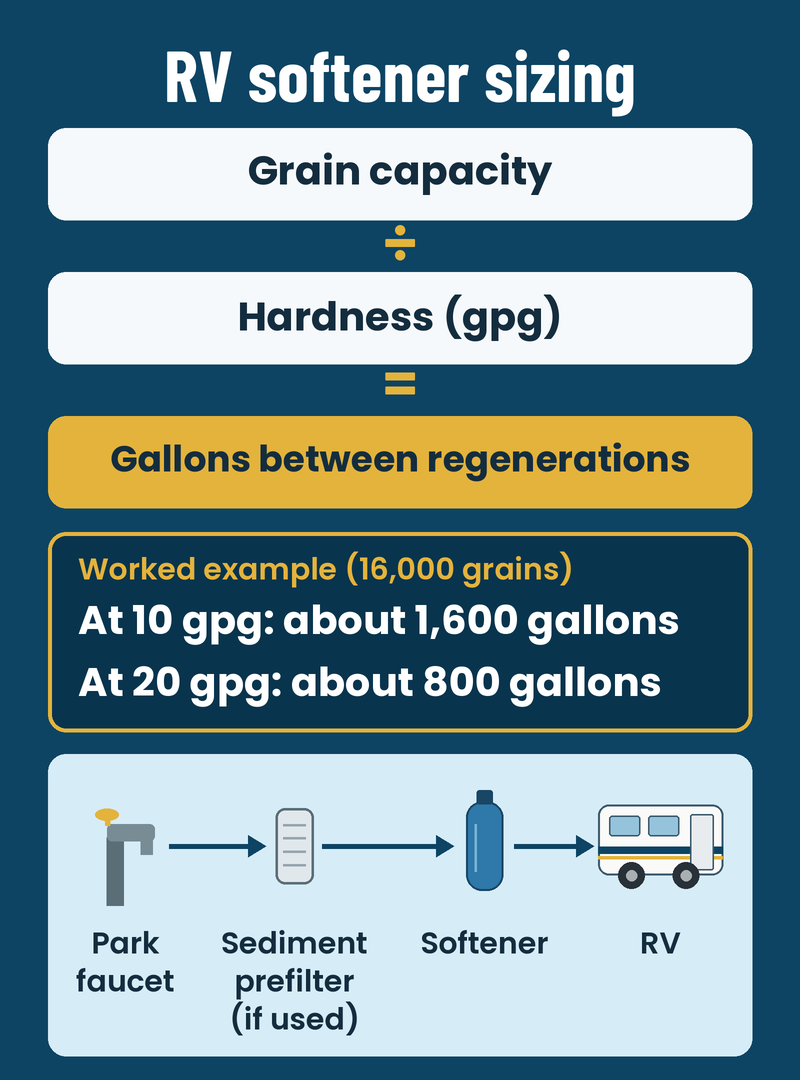
Campground hardness varies a lot from park to park, so test it with hardness strips (several of these kits include them) or check the park’s published water report rather than guessing. VEVOR’s “2,461 gallons, up to 50 days” figure assumes fairly soft 6.5 gpg water. In harder water you’ll get far less.
Our water softener sizing calculator can help with the math. It’s built around household use, and the EPA WaterSense figure of about 82 gallons per person per day is a home number. Overnight RV use is often lower, so treat a household estimate as a rough upper bound.
How regeneration works
The resin inside the tank holds onto hardness minerals until it’s full. Regeneration flushes it with salty water (brine), which pushes the hardness out and recharges the resin with sodium. Per the makers and listings:
- On The Go 8,000-grain: one box of table salt, under 15 minutes.
- On The Go 16,000-grain: two boxes of table salt, under 30 minutes.
- VEVOR RWS16000: 52 oz (1,472 g) of salt per regeneration.
- Camco TastePURE: two boxes of table salt (not included).
- Watts RV PRO-1000: the maker says its custom flow valves let you regenerate without connecting or disconnecting the system.
- Patriot Freedom: regenerates automatically, using about 2.5 lb of salt per cycle, from a brine tank that holds 40 lb.
Salt-based softening swaps hardness for sodium. For what that means, see do water softeners add sodium to drinking water? If the water turns hard again sooner than expected, here are the usual reasons.
Protect any softener from freezing. Patriot’s product page lists a tested temperature range starting at 40°F. For the portable tanks, drain them and store them somewhere frost-free between trips.
The picks, in brief
On The Go OTG4-DBLSOFT (16,000 grains)
A larger version of the classic On The Go tank: 16,000 grains, garden-hose fittings, no power, and two boxes of table salt per recharge. The listing gives up to 1,600 gallons between recharges, and in its own example, 16,000 grains at 11 gpg comes to about 1,454 gallons. At 9.5 in wide and 32 lb, it needs a roomier bay than the 8k model. The listing says it’s made for RVs, not for showers in a house.
Check price on Amazon (affiliate link)
On The Go OTG3NTP3M (8,000 grains)
It’s the narrow one. The listing gives it as 6.75 in across, 22 in tall and 18 lb. It recharges with one box of table salt in under 15 minutes. The listing puts its output at 320–800 gallons, depending on hardness. It comes with test strips, storage caps and a back-flush adapter. In very hard water, expect to recharge it often.
Check price on Amazon (affiliate link)
VEVOR RWS16000 (16,000 grains)
A 16,000-grain tank with 3/4 in brass fittings, a 42 in hose and a shut-off valve in the box, rated to 150 psi, per the listing. It uses 52 oz of salt per regeneration. It’s the shortest 16k tank here at 19.3 in, but it’s 9.6 in wide and 30.8 lb. VEVOR sells several variants, so make sure the listing you open is the RWS16000 you want.
Check price on Amazon (affiliate link)
Camco TastePURE 40655 (10,000 grains)
A middle size at 10,000 grains, with a listed flow rate of up to 4 gpm. The listing gives 8.5 × 8.5 × 20.5 in and 25 lb. It regenerates with two boxes of table salt (not included). The kit includes 50 test strips, a 4 ft hose, a fitting for regeneration and storage caps. The listing marks it “for external use only.”
Check price on Amazon (affiliate link)
Watts RV PRO-1000 / Flow-Pur M7002 (10,000 grains)
Another 10,000-grain tank listed at up to 4 gpm, on a full cradle base, using common table salt. Its selling point is in-place regeneration: the maker says its flow valves let you recharge it without connecting or disconnecting the system. Check the current listing for size and weight before you buy.
Check price on Amazon (affiliate link)
Patriot Freedom (7,000 grains, automatic): currently unavailable
The only automatic unit here. It meters water use and regenerates on demand, using about 2.5 lb of salt per cycle from a 40 lb brine tank, and it runs on a 120 V plug-in adapter, per Patriot Water System. The maker’s size and weight figures differ between sources, so we don’t list one. On November 20, 2026, Amazon showed it as currently unavailable, with no restock date, so there’s no shopping link here.
Common questions
How does an RV water softener work?
A tank of ion-exchange resin swaps calcium and magnesium for sodium as water flows through. In an RV it’s usually a hose-in, hose-out tank at the hookup, not a plumbed cabinet.
How do you regenerate or recharge one?
On a manual tank, add the maker’s salt dose when the water tests hard again, then follow the maker’s rinse or back-flush steps. Automatic units like the Patriot Freedom do this themselves, but you still keep salt in the brine tank.
How do you size an RV water softener?
Divide the rated grains by your water’s hardness in gpg. A 16,000-grain tank at 10 gpg gives about 1,600 gallons between recharges. Harder water or more showers mean more frequent recharges.
Does an RV water softener need electricity?
The manual tanks in this guide don’t, per their listings. The Patriot Freedom needs a 120 V plug-in adapter, per the maker, so it’s a poor fit for unpowered boondocking.
Is an RV water softener the same as an RV water filter?
No. A softener targets hardness. A filter targets other things: sediment, or chlorine and taste with a carbon stage. They do different jobs and are often used together.
Should the softener go before or after a filter?
As general practice, a sediment prefilter goes ahead of the softener to keep grit out of the resin. If the softener maker’s hookup diagram says otherwise, follow the maker.
How is an RV softener different from a household one?
Household softeners are larger, permanently plumbed and often automatic. For examples, see our Kenmore 350 review and Fleck 5600SXT review. Portable RV tanks are smaller, usually manual, and in this check, none had a system listing. Household picks are in our best water softeners guide. Wondering if softening is worth it at all? See are water softeners worth the expense?
New here? Start with our start-here guide.
Sources
Checked November 20, 2026. NSF directory pages were stamped current as of November 19, 2026.
- NSF Drinking Water Treatment Units listings: searches for Patriot Freedom, VEVOR, RWS16000, On The Go, OTG3NTP3M, OTG4-DBLSOFT, Camco and M7002 found no system listing
- WQA Gold Seal product directory: NSF/ANSI 44 keyword searches for patriot, vevor, RWS16000, OTG3NTP3M, camco and M7002 found no listing
- IAPMO R&T product listing directory: no softener listing for Patriot Freedom, RWS16000, OTG3NTP3M, OTG4-DBLSOFT or M7002
- Patriot Water System: Freedom RV water softener product page
- Patriot Water System: Freedom installation instructions (PDF)
- Amazon product listings for each model, checked November 20, 2026.
- EPA WaterSense: statistics and facts (household figure of about 82 gallons per person per day)