
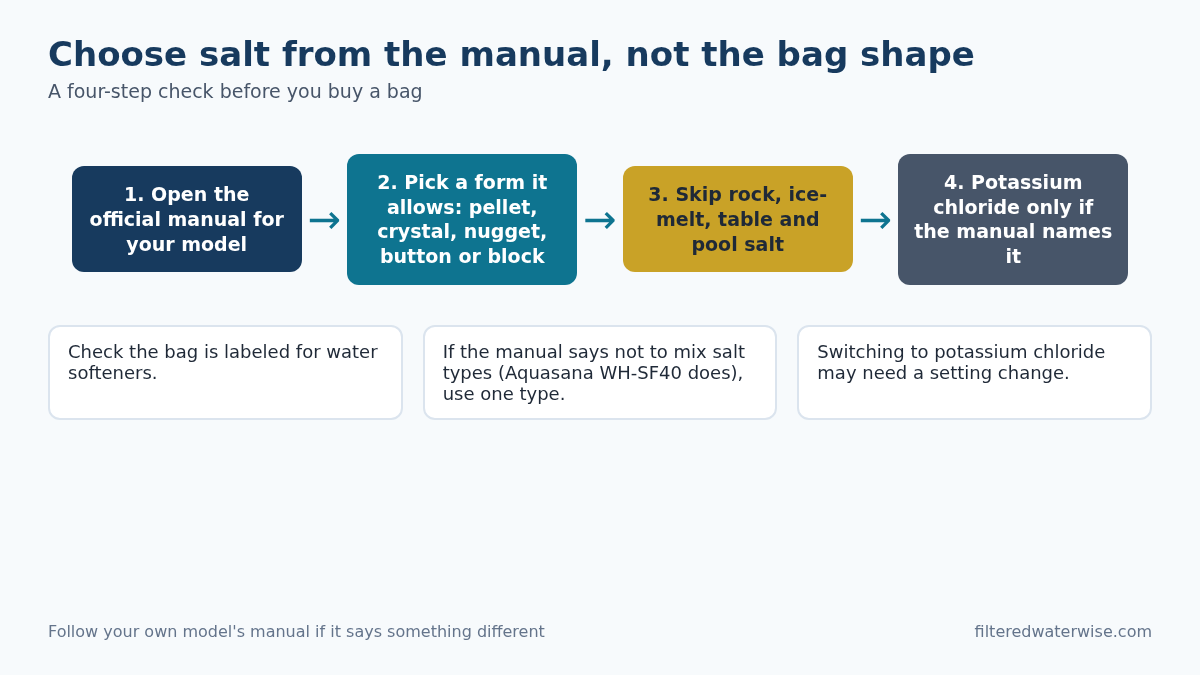
Both pellets and solar crystals can regenerate a household water softener when they are high-purity sodium chloride labeled for softeners and your owner’s manual allows that form. Start with the manual, not the bag shape. Rock salt, ice-melting salt, table salt, and, on some models, block salt are not recommended. Potassium chloride is a different product: use it only if your manual allows it and you follow any setting changes the maker requires. You can estimate how long a 40 lb bag lasts, and bags per year, from your water hardness, household use, and the manual’s salt dose — there is no single number that fits every home. As an Amazon Associate I earn from qualifying purchases. This guide uses maker manuals and official listings checked 20 November 2026. We have not tested these salts or softeners ourselves.
How this guide was put together: we read the official owner’s manuals for softeners Filtered Water Wise already reviews, the NSF International listings for the salts named here, and the current Amazon listings. How we review. Affiliate disclosure.
How softener salt works
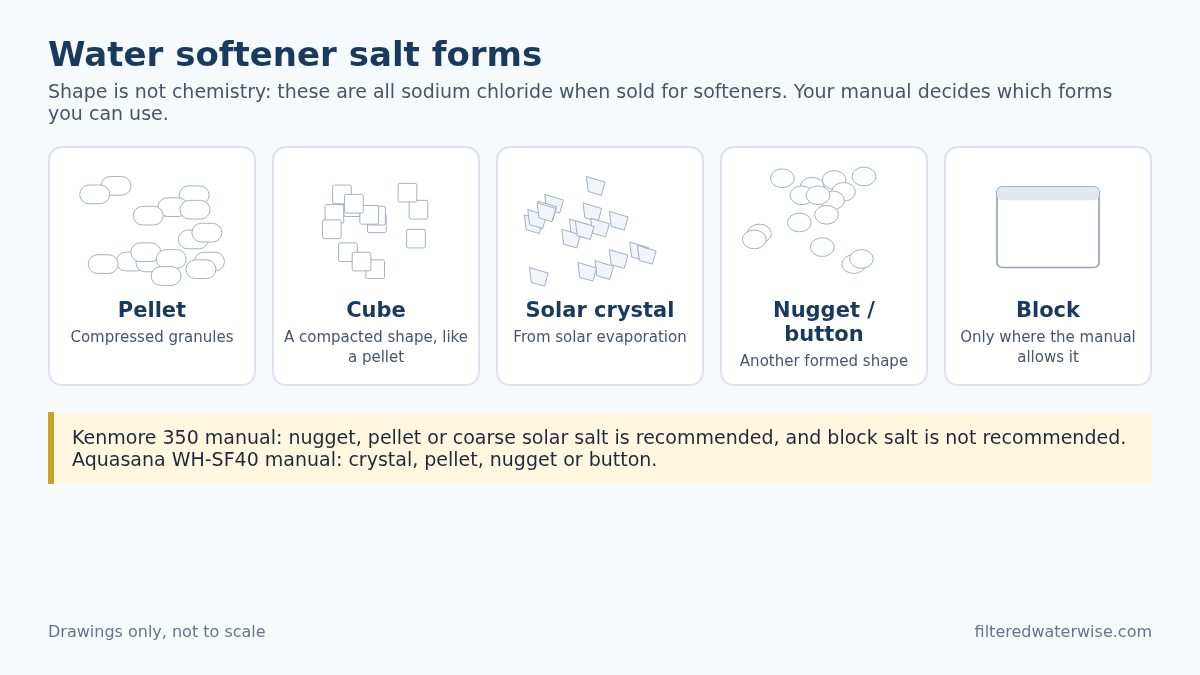
A salt-based softener uses brine made in the brine tank to regenerate its resin, which is what removes hardness. The form of salt (pellet, crystal, nugget or block) changes how it sits and dissolves in that tank. It is not a different softening chemistry, as long as the product is sodium chloride made for softeners and your manual allows it. To check whether a softener is the right size for your water, use our water softener sizing calculator.
Salt forms compared
Swipe to see more →
| Form | What it usually is | What to check | When to skip it |
|---|---|---|---|
| Pellets (and compacted cubes) | Sodium chloride granules compressed into a pellet or cube | The bag is labeled for water softeners, and your manual allows pellets (the Kenmore 350 manual does). One salt maker says the larger shape may be less prone to bridging than smaller crystals. | If your manual names a different required form. Compacted cubes are a shape, not a different chemical. |
| Crystals / solar salt | Sodium chloride crystals from solar evaporation, often sold as “solar” or “coarse solar” | The Kenmore 350 manual allows “coarse solar salts with less than 1% impurities.” The Aquasana WH-SF40 manual allows “crystal.” | If the manual requires pellets or nuggets only, or if the product is not labeled for softeners. |
| Nuggets or “button” salt | Another compressed or formed sodium chloride shape; names vary by brand | The Kenmore 350 manual lists nugget alongside pellet and coarse solar. The Aquasana WH-SF40 manual lists nugget or button with crystal and pellet. | If your manual does not name this form and you cannot confirm it is a softener salt the maker allows. |
| Blocks | Large blocks of salt, sold in various weights | Only if the manual allows blocks. The official Aquasana WH-SF40 manual does not list block (it lists crystal, pellet, nugget, or button). | When the manual forbids blocks, or when a level sensor is designed for a loose bed of salt. Follow that manual. |
| Evaporated salt (a process, not a shape) | A maker description of a high-purity sodium chloride process. One softener-brand support article calls evaporated salt “99.99% sodium chloride.” | Treat this as a purity process, not a substitute for reading the form the manual names. | If the bag is not labeled for water softeners. |
| Rock salt (and similar) | Often sold for other jobs; manuals warn about insolubles | Kenmore 350: not recommended (“rock salt, high in impurities”). Pentair Fleck SXT: do not use rock or snow-melting salt. Fleck 5600SXT upflow: “Do not use granulated or rock salt.” Aquasana WH-SF40: “DO NOT use natural rock salt.” | Skip rock, ice-melting, ice-cream-making, granulated table, and pool salt in a household brine tank unless a current official manual for that unit says otherwise. |
| Potassium chloride | A different regenerant, not sodium chloride | Use only if the current official manual or maker page for your model allows it, and follow any programming change. The Kenmore 350, official Fleck SXT and 5600SXT upflow, and official Aquasana WH-SF40 manuals we opened do not name it. A marketing FAQ on Aquasana’s product page does; the manual still controls. | Do not switch just because a bag is marked “sodium-free.” This page does not give diet advice. |
What your softener manual says
These lines are from the official manuals of softeners Filtered Water Wise already reviews. They are not a substitute for your manual. Confirm the model number on the unit.
Kenmore IntelliSoft 350 (model 625.383500)
- Recommended salt: “Nugget, pellet or coarse solar salts with less than 1% impurities.”
- Not recommended: “Rock salt, high in impurities, block, granulated, table, ice melting, ice cream making salts, etc.”
- Published capacities in that manual: 12,600 grains at 2.5 lb of salt; 26,900 grains at 7.9 lb; 32,100 grains at 13.3 lb. Rated efficiency is 5,040 grains per pound at the 2.5 lb dose.
- The manual we opened does not name potassium chloride.
Read our Kenmore 350 water softener review.
Fleck 5600SXT (Pentair SXT controller and 5600SXT upflow manuals)
- SXT owner’s manual: “Only fill the brine tank with salt designed for water softening.” And: “Only use sodium chloride salt designed for water softeners. Other types of salt (rock or snow melting) may contain dirt and chemicals that will affect the quality of your water and the performance of your water softener.”
- 5600SXT upflow manual: “Do not use granulated or rock salt.”
- Those official Pentair manuals do not name pellets or crystals as a required form, and they do not name potassium chloride.
Read our Fleck 5600SXT 48K review.
Aquasana SimplySoft WH-SF40 (official owner’s manual and performance data sheet)
- “Use only clean salt intended for water softener use, such as crystal, pellet, nugget, or button. DO NOT use natural rock salt. DO NOT mix types of salt.”
- The manual tells the installer to add 80–100 lb of water softener salt, and its install list treats 80 lb as two bags. That is a fill amount for setup.
- The official manual and data sheet we opened do not name potassium chloride or block salt.
Potassium chloride
Potassium chloride can regenerate some softeners, but only when the maker says so. It is not the same product as sodium chloride softener salt, and it may need a different control setting. The Kenmore 350 and official Fleck SXT manuals we opened do not name it. If you switch, follow the current official instructions for your exact model.
Does a salt-based softener add sodium?
Salt-based ion-exchange softeners add some sodium. The amount per gallon depends on the hardness of the incoming water. See Do water softeners add sodium to drinking water? This page does not make health or drinking-safety claims. For personal dietary questions, check local or professional guidance.
How long a 40 lb bag lasts: bags per year
There is no fixed number of bags that fits every home. Work it out from three things: your water hardness, how much water your household uses indoors, and the salt dose your manual lists for your setting.
The method
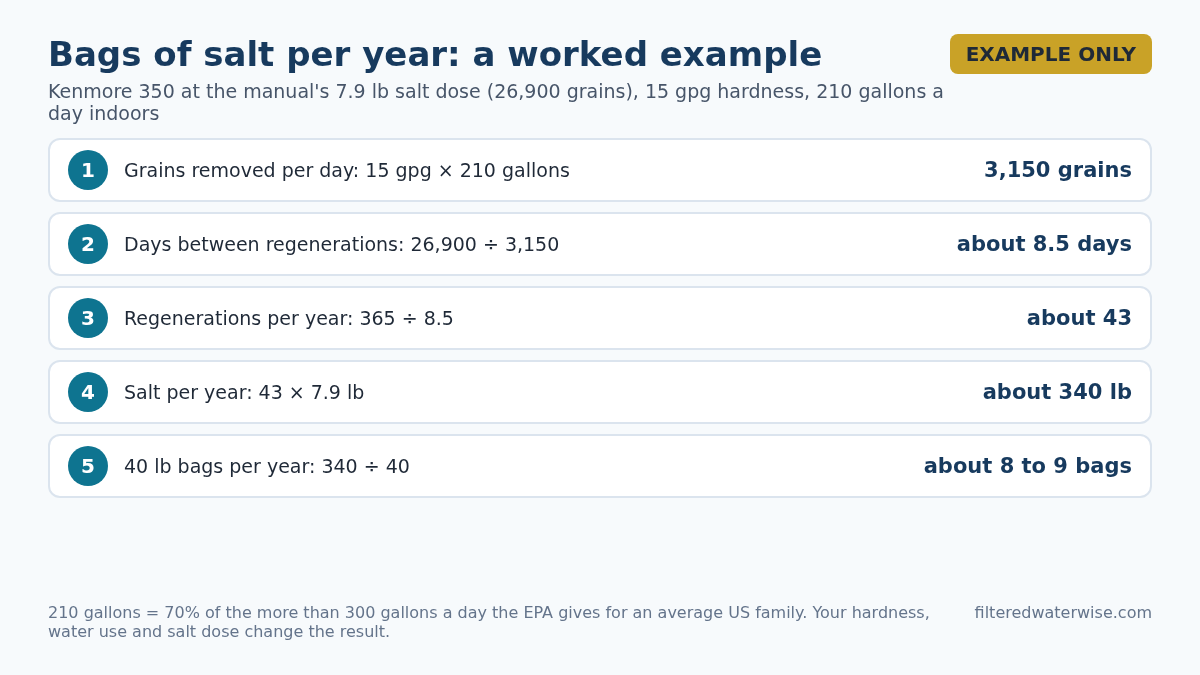
- Grains of hardness removed per day ≈ hardness (grains per gallon) × indoor gallons per day.
- Days between regenerations ≈ the manual’s capacity at the salt dose you actually use, divided by grains per day.
- Regenerations per year ≈ 365 ÷ that interval.
- Pounds of salt per year ≈ regenerations × pounds of salt per regeneration from the manual.
- Bags per year ≈ pounds per year ÷ the bag weight you buy. A 40 lb bag is a common US size (one pellet product is sold in 40 lb and 50 lb bags). Use the bag in your hand.
A worked example (labeled assumptions, not a promise)
- Softener and dose: Kenmore 350 (625.383500) at the manual’s 7.9 lb salt dose, where the published capacity is 26,900 grains.
- Hardness: 15 grains per gallon. This is an example; test your water or read your water report. If you need a test kit, see our Varify water hardness test kit review.
- Household use: the US EPA WaterSense page, opened 20 November 2026, says the average American family uses more than 300 gallons of water per day at home, and roughly 70 percent of that use occurs indoors. This example uses 210 gallons per day of indoor use (70 percent of 300).
- Then: 15 × 210 = 3,150 grains per day; 26,900 ÷ 3,150 ≈ 8.5 days between regenerations; about 43 regenerations per year; about 340 lb of salt per year; about eight to nine 40 lb bags.
Changing the salt dose changes the result. In the same Kenmore manual, the 2.5 lb dose is published at 12,600 grains, and the 13.3 lb dose at 32,100 grains. To check capacity for your own numbers, use the water softener sizing calculator.
Salt bridges and tank habits
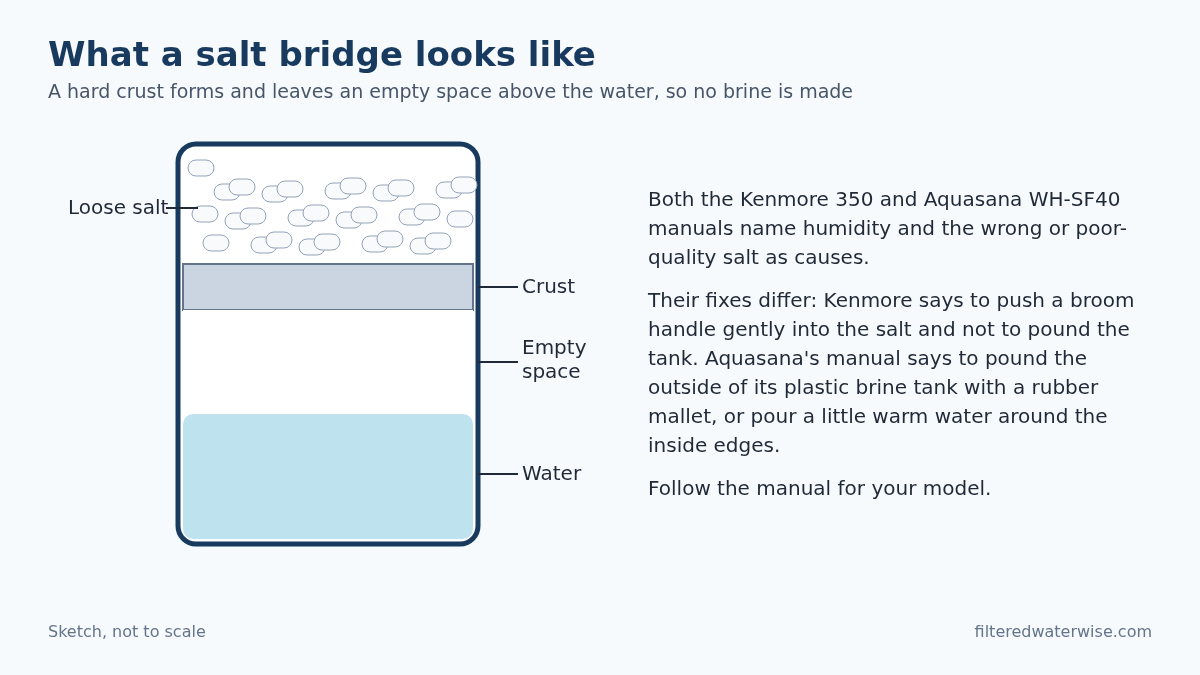
The Kenmore 350 manual describes a salt bridge as a hard crust in the brine tank, usually caused by high humidity or the wrong kind of salt. When salt bridges, an empty space forms between the water and the salt, so the salt does not dissolve to make brine. The Aquasana WH-SF40 manual describes the same problem, caused by humidity or poor-quality salt, and notes it can show up as a lack of soft water or salt that is not being used.
- Kenmore 350: in humid areas, keep the salt level lower and refill more often to avoid bridging. To check for a bridge, push a broom handle gently straight down into the salt; a hard layer before the bottom is most likely a bridge. Break it gently in several places. Do not use sharp or pointed objects, and do not pound on the outside of the tank.
- Aquasana WH-SF40: the manual says to pound on the outside of the plastic brine tank with a rubber mallet, or pour a small amount of warm water around the inside edges, then allow 4 hours for brine to form and regenerate manually. It then says to let the system use up the remaining salt and clean out the brine tank.
- The two manuals give different fixes. Use the one for your model.
If hard water comes back, also see why you might still have hard water with a softener.
When to skip a salt
- Do not put rock salt, ice-melting salt, ice-cream salt, granulated table salt, or pool salt in a household brine tank when the manual forbids them. The Kenmore, official Fleck SXT and 5600SXT upflow, and Aquasana WH-SF40 manuals all warn against rock or similar non-softener salts.
- Use block salt only if that model’s official manual allows it.
- Do not mix salt types in an Aquasana WH-SF40; the official manual says not to. If another manual allows mixing, follow that manual, not a brand FAQ.
- Do not switch to potassium chloride unless the official instructions for your exact model allow it.
- Do not change salt forms just because you can, when the tank already holds a type the manual allows and the system is regenerating normally.
- Portable RV softeners that specify table salt for a manual recharge are a different product class. See our RV water softener guide. Do not treat table salt as the default for a household brine tank.
- A salt-free “conditioner” is not a softener and does not use this salt.
If you are buying a bag
Check two things on the bag: that it is labeled for water softeners, and that its form is one your manual allows. NSF International lists the two Diamond Crystal trade names below to NSF/ANSI/CAN 60, with the product function on the listing rows shown as softener and electrolytic chlorination. NSF listings checked 20 November 2026. This is a listing for the salt, not a performance listing for a softener; softener systems are listed under NSF/ANSI 44 when a unit is certified.
Diamond Crystal Bright & Soft Salt Pellets
A pellet salt. Use it where your manual allows pellets, such as the Kenmore 350 and Aquasana WH-SF40 manuals quoted above. The maker lists 40 lb and 50 lb bags.
Check price on Amazon (affiliate link)
Diamond Crystal Solar Naturals Salt Crystals
A solar crystal salt. Use it where your manual allows crystals or coarse solar salt, such as the Kenmore 350 and Aquasana WH-SF40 manuals quoted above.
Amazon availability changes and can vary by delivery address, so check current availability on Amazon. Heavy salt bags are also often stocked by hardware and home stores.
Common questions
Does it matter if I use crystals or pellets in my water softener?
It matters only to the extent your official manual allows that form and the bag is labeled for softeners. Both are sodium chloride when made for softeners. There is no universal winner based on shape alone.
How long does a 40lb bag of salt pellets last?
There is no fixed number that fits every home. Estimate annual salt use from your water hardness, indoor water use, and the salt dose in your manual (see the method in this article). Then divide that annual amount by 40 to see how many 40 lb bags a year represents. A household with harder water or more indoor use will go through a bag sooner than a smaller household with softer water.
Can I mix salt pellets and crystals for water softener?
Follow your official manual. The Aquasana WH-SF40 official manual says not to mix types of salt. If another model’s official manual allows mixing, follow that manual, not a brand FAQ.
Are Morton salt pellets better than Diamond Crystal?
This page does not rank one brand as better. Compare the bag in your hand to your manual: the form it allows, and any purity or listing printed on that bag. NSF International lists water softener salts from both Diamond Crystal (for example, Bright & Soft Salt Pellets) and Morton (for example, Clean and Protect Water Softener Pellet) to NSF/ANSI/CAN 60; NSF listings checked 20 November 2026. A listing is not a verdict that one brand is better.
Can I use block salt?
Only if your manual allows it. The Kenmore 350 manual lists block salt as not recommended.
Can I use potassium chloride instead of sodium chloride?
Only if the official instructions for your exact model allow it, and only after any required setting change. The Kenmore 350 and official Fleck SXT manuals we opened do not name it. This page does not give diet advice; see the sodium FAQ.
Why is there a crust in the tank?
That may be a salt bridge: a hard crust with a gap above the water, so brine is not being made. The Kenmore 350 and Aquasana WH-SF40 manuals describe this and how to break it up. If hardness returns, also see Why Do I Still Have Hard Water With A Water Softener.
Sources
Manuals and the EPA page checked 20 November 2026. NSF listings checked 20 November 2026.
- Kenmore 350 (625.383500) owner’s manual (PDF): recommended and not-recommended salt, capacities, salt bridges
- Pentair Fleck SXT owner’s manual (PDF): salt designed for water softeners only
- Pentair Fleck 5600SXT upflow manual (PDF): no granulated or rock salt
- Aquasana WH-SF40 / WH-SF60 owner’s manual (PDF): allowed forms, no mixing, salt bridging
- Aquasana WH-SF40 / WH-SF60 performance data sheet (PDF)
- NSF International: NSF/ANSI/CAN 60 listings for Cargill Salt: Diamond Crystal Bright & Soft Salt Pellets and Solar Naturals Salt Crystals
- NSF International: NSF/ANSI/CAN 60 listings for Morton trade names: Morton Clean And Protect Water Softener Pellet
- US EPA WaterSense: How we use water: household water use
- Amazon product listing for Diamond Crystal Bright & Soft Salt Pellets, checked 20 November 2026.
Leave a Reply